5 Signs You Need Driveway Repair in Haltom City TX
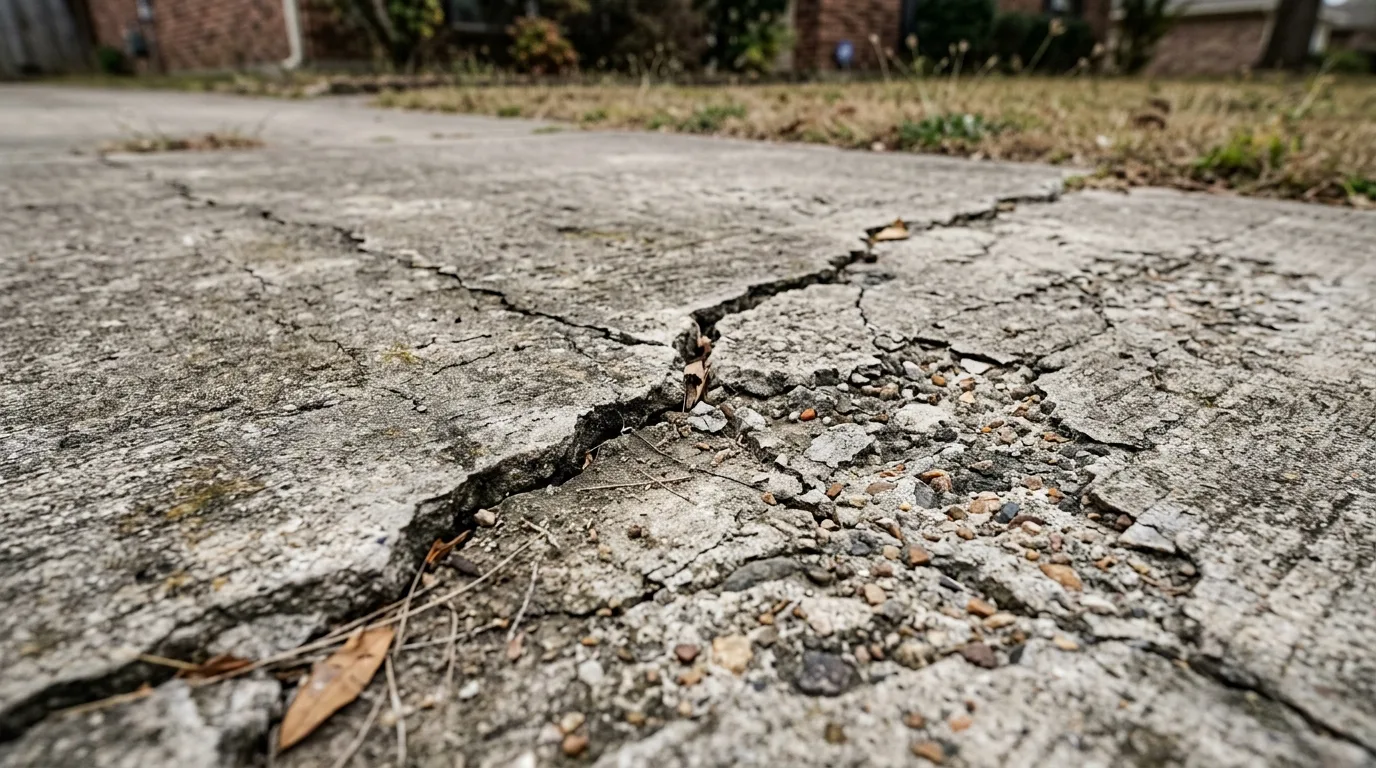
By the time most Haltom City homeowners call about driveway repair, the damage has been visible for at least a season — which means it’s already cost more to fix than it would have a year earlier. Concrete repair in Haltom City follows a pattern: small cracks become wide cracks; hairline fractures let water in, and Tarrant County’s clay soil underneath does the rest. Knowing the five signs that indicate your driveway needs attention now — before a repair becomes a replacement — saves money and extends the life of your concrete. In this post, we cover each warning sign and what it tells you about the underlying condition of your slab.
Get a Free Driveway Repair Assessment in Haltom City
We'll tell you honestly whether repair or replacement makes more sense. Call (888) 376-0955.
Why Haltom City Driveways Deteriorate the Way They Do
Every homeowner who has watched their driveway go from fine to cracked has experienced the same underlying process. Haltom City’s spring rainfall saturates the clay sub-grade beneath the slab. As the soil becomes waterlogged and loses bearing capacity, the slab above it flexes — microscopic flex at first, then visible cracking over several seasons. When summer drought follows, the clay contracts and leaves voids beneath the slab. In neighborhoods like Garden of Eden and Haltom Heights, where homes were built in the 1950s and 1960s on concrete that predates modern reinforcement standards, this cycle has had decades to do its work.
The five signs below map directly to different stages of this deterioration process. Early signs (1–2) indicate a slab that’s still structurally sound and repairable at modest cost. Late signs (4–5) indicate a slab approaching or past the replacement threshold.
Sign 1: Cracks Wider Than 1/4 Inch
Hairline cracks — less than 1/16 inch wide — are normal in concrete and don’t require immediate action. Cracks wider than 1/4 inch are a different matter. A crack that wide allows water to penetrate to the sub-base, where it saturates the clay, reduces bearing capacity, and accelerates settlement. In Haltom City, where the clay sub-grade swells and contracts with every rain-drought cycle, water infiltration through cracks significantly speeds the timeline to structural failure.
The repair: polyurethane or epoxy crack filling to seal the crack, stop water infiltration, and prevent widening. This is one of the most cost-effective repairs available — $200–$600 for a typical driveway — and it works reliably as long as the sub-base is still intact and the crack isn’t symptomatic of full-depth structural movement.
Sign 2: Alligator Cracking Pattern
Alligator cracking — a web of interconnected cracks that resembles the pattern of alligator skin — is a sign that the sub-base has deteriorated across a section of the slab, not just at a single joint. Each “cell” in the pattern is a section of slab that has lost uniform support from below. In Haltom City, alligator cracking typically indicates that clay soil voids have developed beneath the slab from repeated dry seasons, allowing sections to flex independently under load.
Alligator cracking that covers less than 25% of the driveway surface may be repairable with a resurfacing overlay — but only if the sections below the cracking are still stable and not rocking. If the cracked sections move when you walk on them, the sub-base has failed and overlay resurfacing won’t produce a durable result. Full replacement of the affected sections is required.
Sign 3: Heaving or Settled Sections
A driveway section that has risen or settled more than 1/2 inch relative to adjacent sections is a structural problem, not a cosmetic one. Heaving happens when Tarrant County’s clay swells aggressively beneath one section — often triggered by drainage that concentrates water in one area — lifting that section above grade. Settlement happens when voids form beneath a section and the slab drops under load.
Both conditions create trip hazards and drainage problems, but they have different repair approaches. Mudjacking — injecting grout beneath the sunken section to lift it back to grade — can address settlement if the slab is otherwise intact. Heaved sections caused by clay swelling may need the underlying drainage issue addressed before any repair will hold. Either way, sections that have moved more than 1 inch are typically candidates for full replacement.
Not Sure If Your Haltom City Driveway Needs Repair or Replacement?
We'll give you an honest assessment — free of charge. Call (888) 376-0955.
Sign 4: Spalling and Surface Delamination
Spalling — the flaking, pitting, or chunking of the top layer of concrete — is accelerated by Haltom City’s climate combination of intense UV heat and occasional freeze events. When the surface layer of unsealed concrete absorbs heat above 95°F repeatedly, the cement paste near the surface becomes brittle. Winter overnight temperatures in the 34–40°F range cause water that has penetrated the surface to expand slightly, driving further delamination. Once spalling starts, it accelerates — each damaged section exposes fresh concrete to the same UV and moisture cycle.
Surface spalling that affects less than the full depth of the slab can be repaired with polymer-modified mortar or a bonded resurfacing overlay. For concrete resurfacing to work, the slab must be structurally sound — the overlay bonds to the existing surface, not to crumbling aggregate. If the damage extends through more than the top inch of the slab, replacement may be more cost-effective than repair.
Sign 5: Drainage Running Toward the House
This final sign is the most urgent, because it’s not just a concrete problem — it’s a foundation risk. A driveway that slopes toward the garage or home’s foundation — whether due to original construction, settling, or heaving — directs every rain event against the structure. Over time, this concentrates moisture in the soil adjacent to the foundation, which accelerates the clay expansion cycle and can cause foundation movement in the home itself.
Concrete repair for drainage problems usually involves removing and repuring the affected section to re-establish the correct drainage slope — typically 1/8 inch per foot away from the structure. This is a replacement of affected sections, not a surface repair, and it’s worth doing promptly given the downstream foundation risk.
Frequently Asked Questions
How do I decide between driveway repair and full replacement in Haltom City?
Repair makes sense when damage is isolated, the sub-base is intact, and the slab is less than 20–25 years old. Replacement is more cost-effective when alligator cracking covers more than 30–40% of the surface, when structural movement has occurred across multiple sections, when drainage has failed and is causing ongoing foundation risk, or when the slab is more than 30 years old and has no reinforcement. Read our full guide on concrete resurfacing vs. replacement for Haltom City for a complete decision framework.
How much does concrete driveway repair cost in Haltom City?
Crack filling for a typical Haltom City driveway runs $200–$600. Partial resurfacing of a damaged section costs $3–$6/sqft. Full overlay resurfacing for a 500 sqft driveway runs $1,500–$3,000. Section replacement is priced similarly to new flatwork at $4–$8/sqft. Addressing problems at the crack-filling stage is always the most economical path. See our concrete driveway cost guide for Haltom City for full pricing detail.
Can I seal my Haltom City driveway to prevent future damage?
Yes — sealing is one of the most effective preventive measures available. A penetrating silane/siloxane sealer applied every 3–5 years prevents water infiltration through the surface, dramatically reducing the freeze-thaw damage and clay-soil water cycle effects that cause most driveway deterioration. Sealing doesn’t fix existing structural problems, but it significantly slows surface deterioration on an intact slab.
Related: