Clay Soil & Concrete in Haltom City TX: What to Know
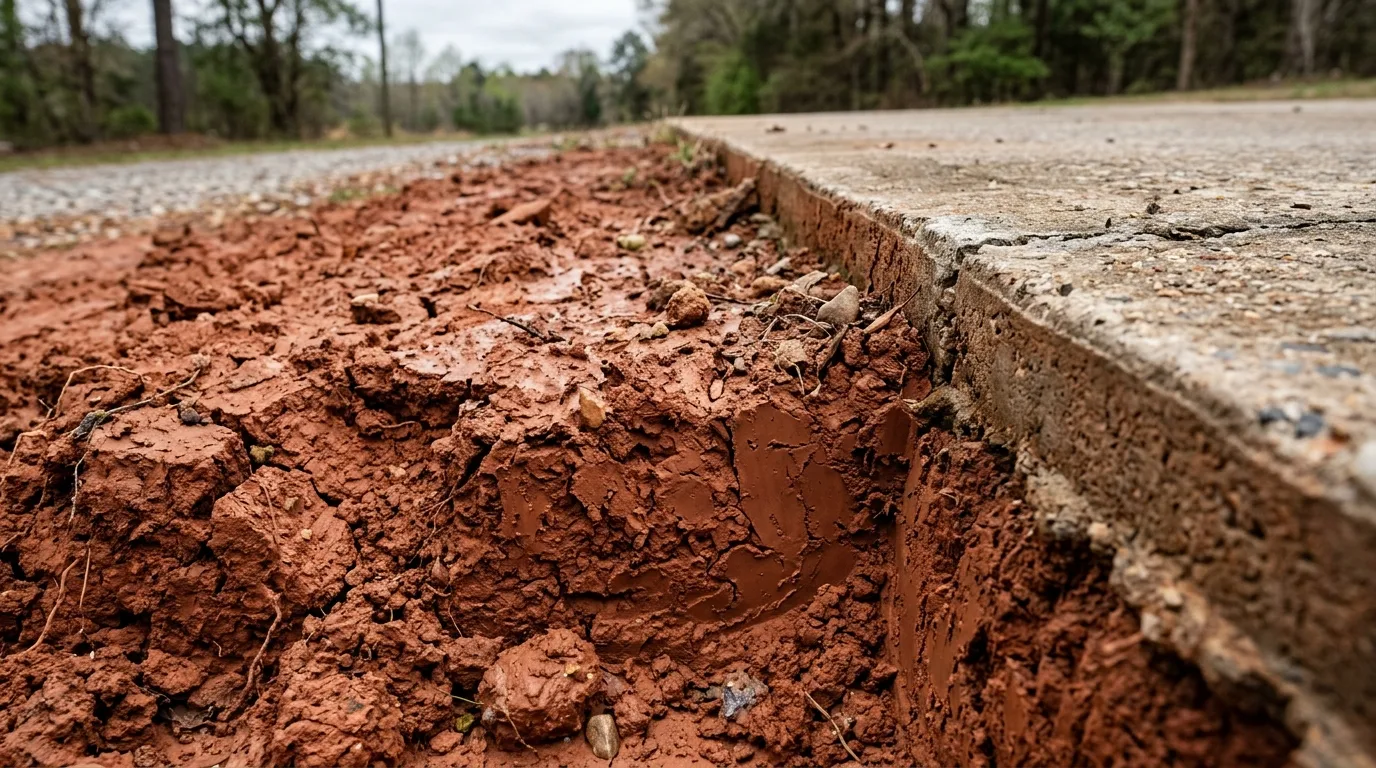
Walk down any street in the Akers or Browning Heights neighborhoods and you’ll see the evidence: driveways with lips where sections have shifted, patios with cracks that trace the same diagonal line year after year, garage floors that rock slightly underfoot. The culprit in nearly every case is the same — Tarrant County’s expansive clay soil, which is the single most important factor in determining whether concrete flatwork in Haltom City lasts five years or fifty. In this post, we cover what expansive clay actually does to concrete, how experienced contractors design around it, and what questions to ask before signing any contract for concrete work.
Get a Haltom City Concrete Estimate Built for Clay Soil
We engineer every project for Tarrant County's soil conditions. Free estimate — (888) 376-0955.
What Makes Tarrant County’s Clay Soil So Problematic
The soil beneath most of Haltom City is classified as Houston Black clay — a series of highly expansive soils with a plasticity index that places it among the most reactive in the United States. “Expansive” in engineering terms means the soil undergoes significant volume changes in response to moisture. When saturated, Haltom City’s clay can expand by several percent of its volume, exerting upward pressure measured in tons per square foot. When it dries — as it does every summer, when temperatures stay above 95°F for weeks at a time and rainfall becomes scarce — that same clay contracts and pulls away from concrete edges, leaving voids.
This cycle repeats every year. Each wet-dry cycle puts concrete through the same stress: upward pressure in spring, void formation and settlement in summer. Concrete slabs without adequate base preparation or reinforcement accumulate micro-damage with every cycle and eventually crack, heave, and settle. North Texas homeowners spend more per capita on foundation repair than almost anywhere else in the country precisely because of this soil — and flatwork failure is just a smaller-scale version of the same problem.
How Proper Engineering Addresses Expansive Clay
The foundation of any well-built concrete project in Haltom City is a properly prepared sub-base. Rather than placing concrete directly on native clay, contractors install a layer of compacted crushed aggregate — typically 4–6 inches for residential driveways and patios, more for foundations and heavy-load slabs. This base layer distributes load over a broader area and provides drainage that prevents the soil directly beneath the slab from saturating after rain. It also bridges minor soil movement, keeping the slab stable even as the ground beneath it shifts slightly.
Reinforcement is the second critical element. Rebar placed in the lower third of the slab creates a tensile element that holds the concrete together when bending forces from soil movement try to crack it. Wire mesh is adequate for lighter applications but rebar is the standard for driveways and anything subject to vehicle loads in Haltom City’s soil conditions. For residential foundations, post-tensioned cable systems go further — the cables are stressed after the concrete cures, putting the slab under internal compression that dramatically increases its resistance to bending and cracking.
Control joints are the third element. Placed at regular intervals — no more than 10 feet apart for a 4-inch slab — they create planned weak points that guide any cracking to the joint rather than across the slab face. Properly designed control joints keep cracks tight, below the surface, and at locations where they’re least visible and least structurally significant.
Questions About Clay Soil and Your Haltom City Concrete?
We explain our base prep approach on every project. Call (888) 376-0955 for a free consultation.
What Happens When Contractors Skip These Steps
Every concrete failure story in Haltom City that ends with a homeowner replacing a driveway after eight years or dealing with foundation movement after a decade usually starts the same way: a contractor cut corners on base prep, reinforcement, or both. A 2-inch gravel base instead of 4–6 inches. Wire mesh instead of rebar for a driveway that carries vehicle loads. Control joints spaced 15 feet apart instead of 10. Each shortcut saves the contractor a few hundred dollars on materials and labor — and transfers the cost to the homeowner in early failure.
The challenge for homeowners is that these shortcuts are invisible once the concrete is poured. You can’t see the base depth or the reinforcement type without cutting into the slab. This is why asking specific questions before any work starts is essential: What is the base depth and material? Rebar or mesh? What size and spacing for control joints? A qualified contractor answers these questions with specifics. A contractor who deflects or gives vague answers is telling you something important.
Cost Implications for Haltom City Concrete Projects
Proper clay-soil engineering adds real cost to concrete projects in Haltom City — concrete flatwork that runs $4–$8/sqft in easier-soil markets can run $5–$9/sqft in Tarrant County when base preparation is done correctly. Concrete foundation costs reflect similar premiums for post-tensioned designs and engineer fees. This is not a sign of an overpriced contractor — it’s a sign of a contractor who understands what the job actually requires.
The alternative math is straightforward: a driveway that costs $3,500 properly built and lasts 35 years costs $100/year. A driveway that costs $2,200 built on shortcuts and needs replacement in 10 years costs $220/year — and you pay $2,200 again at the 10-year mark. Concrete slab installation done right the first time is always the better investment in Haltom City’s soil conditions.
Frequently Asked Questions
How do I know if a contractor is properly preparing for Haltom City’s clay soil?
Ask specifically: What base depth are you using, and why? Will you use rebar or wire mesh? How far apart will the control joints be? A contractor who can answer these questions with specifics and who references local soil conditions in their explanation is demonstrably better qualified than one who quotes generically. Also ask whether they’ll compact the base with a plate compactor — hand-raking is not adequate.
Is post-tensioned concrete always necessary in Haltom City?
Post-tensioned slabs are strongly recommended for residential foundations and large flatwork in Haltom City because Tarrant County’s clay plasticity index is high enough to cause conventional rebar slabs to crack over time. For smaller flatwork — patios under 400 sqft, small utility slabs — conventional rebar-reinforced concrete with a proper base is adequate. For anything structural, post-tensioning provides significantly better protection against long-term clay soil movement.
Does the clay soil affect when I should pour concrete in Haltom City?
Soil moisture conditions matter for base preparation more than for the pour itself. Very wet clay is difficult to compact to the density needed for a stable base. Fall is particularly good for foundation and large flatwork pours because the soil has dried from summer heat and reached a stable, compactable condition. Read our full seasonal guide to concrete pours in North Texas for detailed timing recommendations.
Related: