Concrete Slab Foundations for New Haltom City Homes
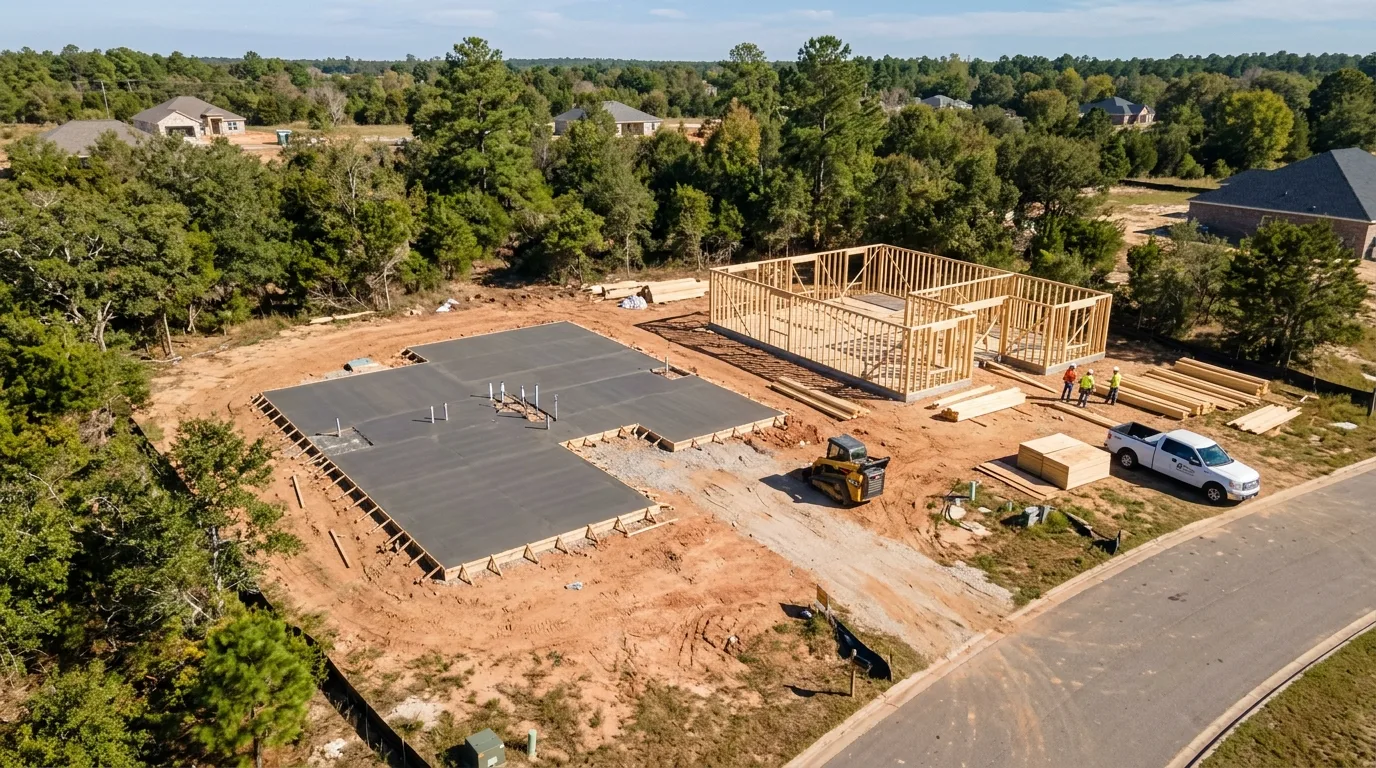
A concrete slab foundation is the starting point of every new home built in Haltom City — and the most important structural element the homeowner will ever invest in. Unlike a driveway or patio that can be replaced if it fails, a residential foundation is the platform on which everything else sits. Getting it right the first time requires understanding what makes Tarrant County’s soil different from most Texas markets, what design choices that difference demands, and how to evaluate whether a builder’s concrete contractor is actually meeting those standards. In this post, we explain how concrete slab foundations for new Haltom City construction work, what they cost, and what homeowners and builders should expect from a qualified foundation contractor.
New Construction Foundation in Haltom City?
We coordinate engineering, permits, and construction. Free estimate — call (888) 376-0955.
Why Haltom City Foundation Design Is Non-Standard
New construction in the Bluffs at River East neighborhood and on infill lots throughout Haltom City is being built on some of the most reactive soil in North Texas. Tarrant County’s Houston Black clay has a shrink-swell potential — technically called linear extensibility — that causes measurable volume changes with seasonal moisture variation. In the context of a new home foundation, this means the ground beneath the slab is never truly static: it swells after spring rains and contracts during summer drought, every year, for the life of the structure.
A foundation designed for a market with stable sandy or loam soils — with minimal grade beam depth, standard rebar grid, and no moisture management provisions — will begin showing stress within the first 5–10 years in Haltom City’s conditions. Foundation repair in the DFW area is one of the largest residential repair cost categories precisely because of this gap between national building standards and what Tarrant County’s soil actually requires.
Post-Tensioned Slab Foundations: The Haltom City Standard
Post-tensioned slab construction is the industry standard for residential foundations throughout Tarrant County and the broader DFW area — and for good reason. The concept is straightforward: high-strength steel cables are laid in a grid pattern before the concrete pour. After the concrete reaches sufficient strength, a hydraulic jack stretches the cables and they’re locked at the ends. The cables’ tension puts the concrete slab under internal compression, making it significantly more resistant to the bending forces that expansive clay generates.
A conventional rebar-reinforced foundation resists bending by allowing the steel to carry tension after the concrete has cracked. Post-tensioning prevents the crack from forming in the first place — a fundamentally better response to the high-volume-change soil conditions in Haltom City.
The design for every post-tensioned foundation in Haltom City should be produced by a licensed structural engineer who has performed or reviewed a geotechnical soil report for the site. The engineer specifies: cable density and spacing, grade beam dimensions and depth, perimeter beam reinforcement, and moisture management provisions around the perimeter.
What a Properly Engineered New Construction Foundation Includes
Geotechnical soil report: A soil boring at the site establishes the actual plasticity index and bearing capacity at the specific location. Foundation design should be based on site data, not generic Tarrant County assumptions. Soil reports cost $400–$800 and are worth every dollar.
Structural engineer’s design: The engineer translates the soil data into a foundation specification — cable layout, grade beam schedule, slab thickness, perimeter drainage requirements. Engineer-stamped drawings are required for all foundation permits in Haltom City.
Grade beam design: Grade beams — the thickened concrete ribs that run beneath the slab and around the perimeter — provide the structural depth that resists differential movement. Grade beam depth is the most important variable for performance in high-plasticity clay; deeper grade beams that reach more stable, less reactive soil layers perform significantly better than shallow ones.
Perimeter moisture management: Maintaining consistent soil moisture around the foundation perimeter reduces the amplitude of seasonal swelling and shrinkage. This typically involves a perimeter drainage system that prevents water from concentrating against the foundation and plantings kept away from the perimeter to reduce moisture competition.
Foundation Contractor for New Haltom City Construction
Engineer coordination, full permit management, post-tensioned or conventional. Call (888) 376-0955.
Foundation Installation Timeline and Process
Permit timeline: Foundation permits in Haltom City require engineer-stamped drawings and plan review by Planning & Community Development at 817-222-7730. Plan review typically takes 5–10 business days. Permits should be applied for early in the construction schedule.
Site work: Excavation and grading, utility rough-ins (plumbing under-slab), and sub-grade preparation take 2–3 days for a typical residential lot.
Forming and reinforcement: Grade beam forms are set, rebar placed, and post-tension cables laid in the specified grid pattern. This takes 1–2 days for a standard residential footprint.
Pour day: The concrete is poured monolithically — slab and grade beams in a single continuous pour. A residential foundation pour typically takes a full day including finishing.
Cable stressing: Post-tension cables are stressed after the concrete reaches 2,500 PSI — typically 3–5 days after the pour in warm weather. Stressing is performed by a certified technician.
Cure and framing: Framing typically begins 7 days after the pour when the concrete has reached approximately 70% of design strength. Full 28-day cure continues while framing proceeds.
Foundation Cost for New Haltom City Construction
Post-tensioned residential foundation cost in Haltom City runs $6–$10/sqft — a 1,500 sqft foundation costs $9,000–$15,000, including engineering fees, materials, and installation. Conventional rebar foundations run $4–$6/sqft for the same footprint. The premium for post-tensioning — $2–$4/sqft — is a modest investment relative to the risk it mitigates over a 30–50 year home lifespan.
Site-specific costs add to the base: difficult excavation on infill lots, complex footprints with numerous corners and re-entrants, high-plasticity soil requiring deeper grade beams, and drainage correction all add cost. We provide itemized written estimates that separate each cost element.
Frequently Asked Questions
Do all new homes in Haltom City need a post-tensioned foundation?
Post-tensioned foundations are strongly recommended for all residential construction on Haltom City’s expansive clay soil. Conventional rebar foundations are occasionally used for smaller accessory structures (detached garages, workshops) where the risk tolerance is different than for the primary residence. For any structure where long-term stability matters, post-tensioning is the appropriate choice in Tarrant County conditions.
What permits are required for a new construction foundation in Haltom City?
All residential foundations in Haltom City require a building permit with engineer-stamped drawings from Planning & Community Development at 817-222-7730. Post-tensioned designs require structural engineering documentation as part of the permit package. We handle the full permit process including coordination with the structural engineer. Read our Haltom City concrete permit guide for complete requirements.
How do I verify my builder’s foundation contractor is qualified?
Ask for the structural engineer’s name and credentials, a copy of the soil report, and the engineer-stamped foundation drawings before the pour. These documents should exist for any properly permitted foundation. Verify that the contractor has experience with post-tensioned construction in Tarrant County specifically — not just in Texas generally — and that the cable stressing will be performed by a certified technician, not just the concrete crew.
Related: