Concrete Curing in Haltom City TX: How Long to Wait?
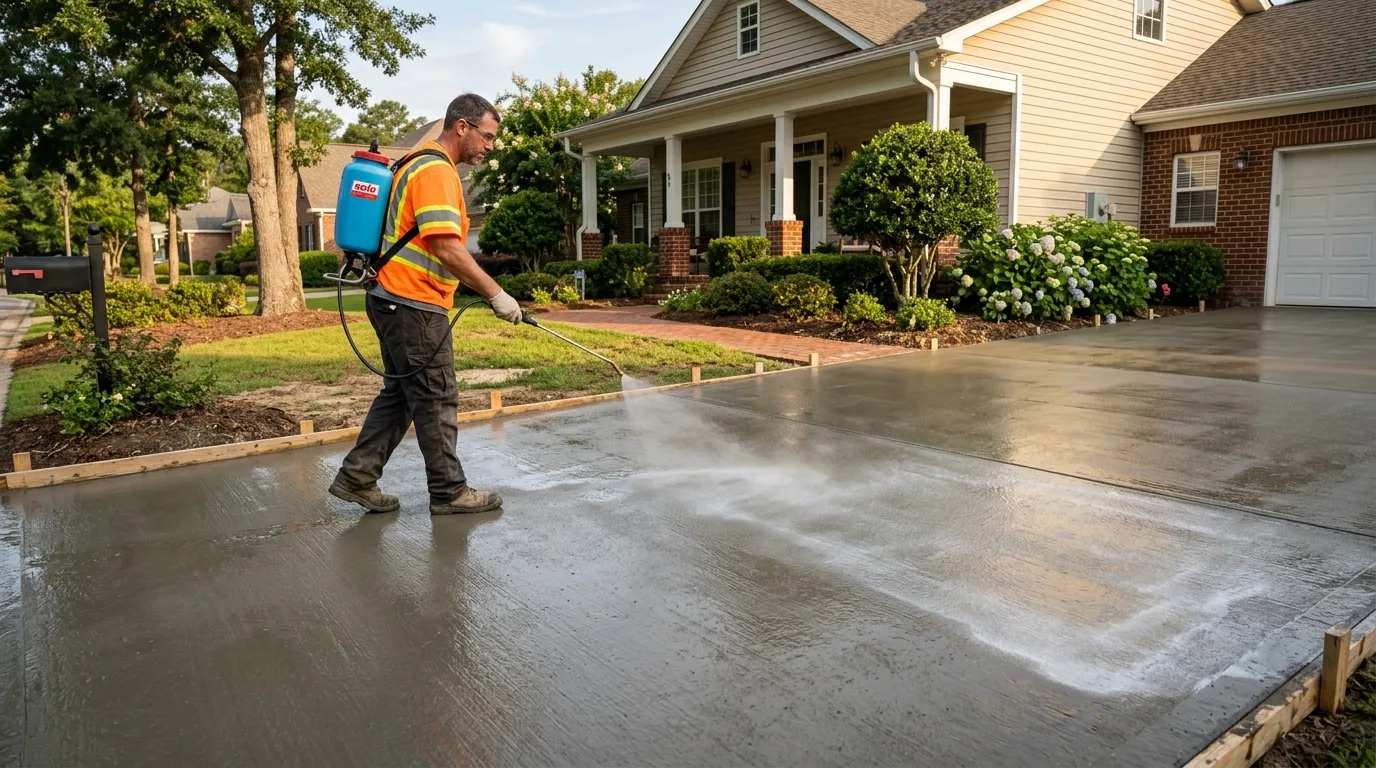
Your new concrete slab looks solid — so why does your contractor say you can’t drive on it for a week? Concrete curing in Haltom City follows a timeline that’s affected by Texas heat, humidity, and the specific mix design used on your project. Understanding what “curing” actually means, when each milestone is reached, and how North Texas conditions affect the timeline helps homeowners plan around a new slab and avoid accidentally damaging a fresh pour. In this post, we cover the complete curing timeline for driveways, patios, and foundation slabs in Haltom City.
Questions About Your New Haltom City Concrete Slab?
We give you a complete care timeline with every project. Call (888) 376-0955.
What Concrete Curing Actually Means
Curing is not drying — that’s a common misconception. Concrete gains strength through a chemical process called hydration, in which water reacts with cement particles to form the crystalline structure that gives concrete its strength. This process requires water to be present and requires time. Drying out too fast — as happens when Haltom City summer heat evaporates moisture from fresh concrete — doesn’t speed up curing. It interrupts it, producing a slab with lower final strength and greater surface cracking risk.
The goal of curing management is to keep the concrete from losing moisture too fast for the first 7–14 days while chemical reactions build strength. On summer pours in Haltom City, where temperatures regularly exceed 95°F and relative humidity drops in the afternoon, this is active work: curing compounds applied to the surface immediately after finishing, wet-cure blankets on slabs where additional protection is needed, and protection from direct sun on the first day.
Curing Timeline for Haltom City Concrete
24–48 hours: The concrete has hardened enough for light foot traffic — walking carefully on the surface without leaving marks. Do not place heavy objects or allow children to play on the surface. Stamped concrete may have slightly different timing depending on the thickness of color hardener and release agent used.
7 days: The concrete has reached approximately 70% of its 28-day design strength. Passenger vehicles (cars, SUVs, pickup trucks) can be parked on the slab. For driveways, this is the practical point at which normal residential use begins. Patio furniture can be placed carefully.
28 days: Full 28-day cure — the standard concrete strength specification is measured at this point. This is when the slab has reached its rated design strength. Heavy vehicles (RVs, heavy trucks, loaded trailers) should wait until this milestone. This is also when the first sealer coat should be applied for bare concrete.
Post-cure sealing: For stamped concrete in Haltom City, we apply the first sealer coat at 28 days as part of the installation. For standard broom-finish concrete, homeowners have the option of applying a sealer immediately at 28 days or waiting. Sealing at 28 days provides the best protection against moisture infiltration and UV degradation from North Texas’s intense sun.
How Haltom City’s Summer Heat Affects Curing
Concrete poured in July in Haltom City faces the most demanding curing conditions of the year. With air temperatures above 95°F and direct sun heating the slab surface to 130°F or more, moisture evaporation rates can exceed the rate at which bleed water is released from the concrete — creating a moisture deficit in the surface layer that causes plastic shrinkage cracking within hours of placement.
Experienced contractors mitigate summer curing challenges with a combination of measures: scheduling pours at dawn when temperatures are lowest; using retarding admixtures to slow set time; applying evaporation retarder to the surface immediately after screeding; using curing compounds or wet-cure blankets after finishing; and scheduling inspections of the blanket coverage during the first 24 hours. These measures collectively keep the surface hydrated through the critical first day and produce summer-poured slabs that meet the same strength and surface quality standards as spring and fall pours.
New Slab in Haltom City — We Give You a Full Care Guide
Every project comes with specific curing and maintenance instructions. Call (888) 376-0955.
Curing for Different Slab Types
Concrete driveways: Full curing to 28 days before heavy vehicle use. Passenger vehicles at 7 days. The driveway can be sealed at 28 days — we recommend it to protect against Haltom City’s summer UV and the clay soil moisture fluctuations that affect surface concrete.
Concrete patios: Foot traffic at 24–48 hours. Furniture placement at 7 days. For stamped concrete patios, the sealer applied at 28 days is the key UV protection step — don’t skip it or delay it significantly in Tarrant County’s sun exposure.
Foundation slabs (concrete slab foundations): Framing cannot begin before the foundation has achieved sufficient strength — typically a minimum of 3,000 PSI compressive strength, which is reached at approximately 7 days for standard mix designs in favorable conditions. Post-tensioned slabs must reach sufficient strength before stressing — typically 2,500 PSI, usually achieved in 3–5 days. Your structural engineer’s design documents specify the minimum strength for each milestone.
Cost Impact of Proper Curing
Hot-weather curing measures — retarding admixtures, curing compounds, wet-cure blankets — add approximately $0.25–$0.75/sqft to the cost of summer concrete work in Haltom City. This is a modest cost relative to the value of proper strength development and surface quality. Contractors who skip these measures to save material cost are passing the risk of surface defects and reduced strength to the homeowner. Ask specifically what curing measures are included in any summer-season concrete estimate.
Frequently Asked Questions
Can I water my new concrete slab to help it cure?
Wet curing — keeping the concrete surface consistently moist — is actually an excellent curing method that helps maintain the hydration needed for strength development. Homeowners who keep a new slab wet by running a soaker hose or placing wet burlap on it for 7 days are doing exactly what the chemistry requires. The key is consistency — cycles of wet and dry are worse than either consistently wet or consistently dry. This matters especially for Haltom City’s dry summer conditions.
What happens if it rains on my fresh concrete in Haltom City?
Light rain that starts after the concrete has been finished and the surface has hardened (typically 4–6 hours after pour) is usually harmless or even beneficial. Heavy rain that hits concrete that hasn’t yet hardened can damage the surface finish and wash away fine particles. We monitor weather forecasts when scheduling pours and have protective measures available for unexpected rain events. Tarrant County’s spring rain patterns are the main scheduling consideration.
Why does my new concrete look different colors in different spots?
Uneven color in freshly poured concrete — called mottling or efflorescence — is normal and typically resolves as the concrete fully cures and dries to a uniform moisture content. Excess water in the mix, variations in finishing technique, and differential drying rates from sun exposure all cause initial color variation. Most color inconsistency is gone by the 28-day mark. See our best time to pour concrete in North Texas guide for how seasonal conditions affect curing appearance.
Related: